


|
Mohair
|
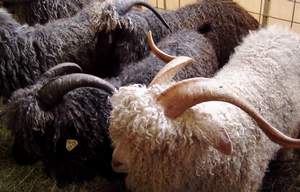
Mohair is often thought to come from a Mo. What is a Mo? I don't know. But, I do know this - it is an animal fiber. This fine fiber actually comes from the Angora Goat. This goat is native to the Angora region of Turkey, but is now raised mainly in South Africa and the United States.
The Angora goat grows beautiful long curly locks of fiber, as you can see in the photographs. This wonderful coat of fine fiber is sheared either once or twice a year, depending on the staple length (fiber length) required.
These mohair fibers can be from 8 - 12 inches in length and come in a variety of shades. They used to be bred only in white so that the fiber could be dyed, though Angora goats are now bred in "reds" (apricot through to copper shades) or "blacks" (shades of grey through to black). The white takes dyes easily, evenly and holds them permanently.
This is a very smooth, strong fiber, which will not shrink or felt as easily as wool. Its' fibers tend to stick out when felted in a wool blend yarn and give a "halo" of fuzz over the felted project.
Mohair will not crease or wrinkle easily and is very long lasting. It is not entirely a rare fiber, but yarns containing mohair tend to be a little more expensive as it is considered a fairly luxurious fiber.
These yarns, in general, tend to have a halo of fuzz around the strand. They can be worked up quickly into wonderfully warm but very lightweight scarves, shawls, sweaters, hats, etc.
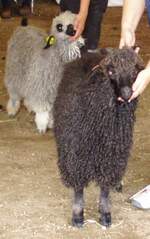 Angora goats are pretty easy to look after. They eat grass hay and pellets and are reasonably disease-resistant. They also love to eat, and are not harmed by, noxious weeds, which also makes them particularly useful for keeping the yard in check.
Imagine having a herd of these cute, fiber producing goats taking care of your yard, leaving you more time to play with yarn and fibers. Sounds idyllic to me. Do give mohair a try - it's a wonderful fiber.